
Presented by Richard T. Young,
Vice President of Corporate Services
Good morning, Mr. Chairman and members of the Legislative Transition Task Force. I am Richard Young, vice-president of corporate services for Rappahannock Electric Cooperative, which, for brevity, I will refer to as REC.
REC is a consumer owned electric cooperative. Our roots go back sixty-three years and seven days when, on June 16, 1936, Virginia Electric Cooperative was formed in Bowling Green, Virginia. A few years later Northern Piedmont Electric Cooperative began operating in Culpeper. In 1980, the two cooperatives consolidated their operations to form REC.
Today, REC is headquartered in Fredericksburg, and has district offices in Bowling Green and Culpeper.
REC delivers electricity to more than 76,000 meters – making it the second largest electric cooperative in Virginia in terms of number of meters. We are experiencing growth rates of approximately 3.2% annually, yet we still average just over 7 meters per mile of line. In comparison, Virginia Power's average is closer to forty meters per mile.
REC has the largest geographic service area of any cooperative in Virginia. We maintain nearly 10,000 miles of line in order to serve our member-owners, who are located in portions sixteen counties, ranging from Fauquier in the northwest, south to Albemarle, and south east to King and Queen.
The service area includes parts of four Senate districts, nine House districts, and two congressional districts. We estimate more than 150,000 Virginians depend on our services each day.
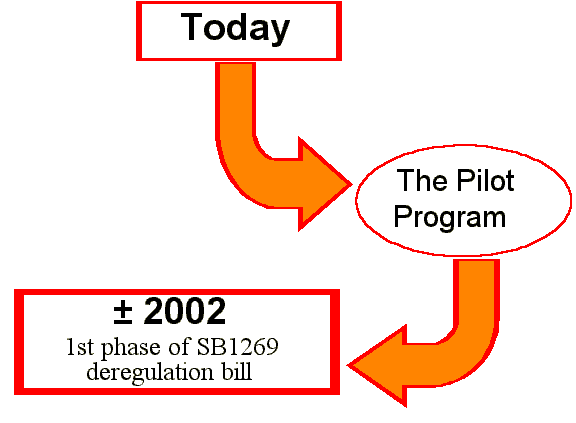
This morning I will briefly outline REC's participation in the Retail Choice Pilot Program. I will cover the perceived purpose for conducting the pilot, some key issues relating to the pilot, and the mechanisms we will use to conduct the pilot. I will also provide a general timeline and summarize some of the unanswered questions relating to the pilot. Please feel free to ask questions at any time.
The Cooperative has four primary goals we hope to achieve through participation in the pilot:
To this point, most of the effort has focused on the Interim Rules and the necessary infrastructure – which primarily concentrates on the electronic exchange of data, commonly referred to as EDI. As you may have guessed, these are two of the three Key Issues. The third issue is Consumer Education. Three separate groups have simultaneously worked to address these issues: the Interim Rules Task Force, the Electronic Data Transfer Working Group, and the Consumer Education Task Force. The Cooperatives have had representation on all three of these task groups.
The Interim Rules Task Force was created in response to the State Corporation Commission's Order number PUE980812, issued on December 3, 1998. The group met at least weekly beginning in January, and presented its report to the Commission on March 9, 1999. One month later, and just ten days prior to a public hearing on the proposed rules, the Commission staff issued its own recommended rules. A hearing was held for the general public as scheduled on April 19, 1999. The Local Distribution Companies (LDC – a.k.a. utilities) and the Competitive Service Providers (CSP – a.k.a. marketers) who had participated on the task force asked for an extension on their portion of public hearing. The extension provided additional time to thoroughly review and prepare comments on the staff's recommendations.
The hearing for LDCs and CSPs was held on May 3, 1999. The Hearing Examiner's report on the public hearings and the various recommendations was to be released on June 11, 1999. As of this time, we have not received this report.
We have a number of concerns about the Interim Rules, but there are two points that I want to stress:
There are many differences between Virginia's electric cooperatives and the state's other utilities. Primary among those differences is the size of the organization and the resources available to it. Cooperatives are much smaller – in fact, three of the cooperatives have fewer than 40 employees, with the smallest having only 24 employees. To require a totally separate staff, a totally separate facility, and to not allow any sharing of resources between the cooperative and its affiliates would place a disproportionate burden on the cooperatives.
The weight of this issue cannot be underestimated. Based on the experience in Pennsylvania and other states, cooperatives may be the only ones interested in providing services to residential and small commercial customers, especially those in rural areas. In order for competition to be successful, all consumers - large and small, urban and rural - must have competitors from which they can choose. We believe that allowing cooperatives to provide competitive services, without undue burdens, will be essential for the success of any retail customer choice program.
We also propose that metering and billing remain with the local distribution company during the pilot. The task of educating consumers about their opportunities relating to power supply is tremendous. To make metering and billing available on a competitive basis would only add to the confusion and would increase the opportunity for questionable billing practices.
A major challenge during the pilot and into full retail competition will be handling the large volume of data that will be created and efficiently distributing that data to all of the parties involved. The list of entities needing to share data include, but are not limited to, the local delivery company, the transmission entity, the competitive service provider, the generator, and the customer. REC is actively participating in the Electronic Data Transfer Working Group to develop standards that will be effective and acceptable to all.
The third critical ingredient for a successful pilot will be educated consumers. As you know, the Commission is coordinating this effort. We recommend that the educational programs be coordinated with the introduction of the pilot programs so that consumers who wish to choose may do so before their interest diminishes. Also, by first focusing on the pilot areas, the effectiveness of the educational materials can be evaluated prior to distributing them to all Virginians.
Now, I will provide an overview of REC's pilot proposal, which we call Energy Choice. This is a work in progress, and will be appropriately modified as additional information becomes available from the Commission.
REC proposes to include in our pilot approximately 1.4% of our system load. This amounts to 5 megawatts and will allow around 900 customers to participate. Customers from throughout our sixteen county service area will be eligible. Our filing will be coordinated through our wholesale power supplier, Old Dominion Electric Cooperative, and it will coincide with Mecklenburg Electric Cooperative's filing.
Energy Choice will be open to all REC customer classes: residential, small commercial, and large commercial and industrial. The amount of load dedicated to each class will roughly match REC's existing load characteristics. The selection method for each class will differ slightly.
We will solicit 2,000 randomly selected residential customers and the first 875 to respond will be allowed to participate. We will continue to randomly solicit customers until we have an adequate number of participants. A standby list will be maintained if we receive more than 875 responses. A total of 3.5 megawatts will be assigned to the residential portion of the pilot.
We define small commercial customers as loads less than 200 kW. We will offer participation in the pilot to 100 randomly selected customers. Participation will be on a first to respond basis and we will accept requests to participate until the amount of small commercial load in the pilot equals .4 megawatt. We anticipate it will take 15 to 20 customers to reach that total.
Large commercial and industrial customers are those with loads greater than 200 kW. REC has 125 customers that meet this criteria. All of these customers will be offered the opportunity to participate in the pilot. Actual participants will be randomly selected from those who express an interest in the pilot. We have assigned 1.1 megawatts of load to this portion of the pilot. It is possible that one customer could fulfill this load requirement, and we know there will be no more than 5 large commercial and industrial customers participating.
In April, REC created a team dedicated to designing and implementing the Energy Choice pilot program. The team has developed a timeline that should have Energy Choice fully operational by this time next year.
For cooperatives, both the pilot and full retail competition create some unique challenges. Some of those are noted on the timeline. Such things as the Cooperatives' Bylaws must be thoroughly evaluated to ensure that there are no negative impacts on customers who choose a competitive energy supplier.
We must also address issues such as different levels of membership for members as we know them today, for those who may only receive delivery services, and for those who may only receive competitive services. Closely related to that is the question of how patronage capital is to be assigned and who should bear the financial burden of conducting the pilot.
The issues of separation of facilities and employees of CSPs and LDCs and the potential of making metering and billing a competitive service will also have a disproportionate impact on Cooperatives and their customer-owners. These are important not just for Cooperatives, but the success of retail competition in Virginia. All customers-- residential and commercial, rural and urban-- must have fair opportunities to participate and at least have the potential to benefit from retail choice.
Rappahannock Electric Cooperative is committed to making sure the residential and small commercial customers, many of which are rural in nature, reap the advantages of electric deregulation and are not disadvantaged by the implementation of competition.
Consumer-owned cooperatives should not be disadvantaged by the implementation of competition. A cooperative is unique in that it is not the institution that would be harmed, but it would directly harm individual customers--our owners.